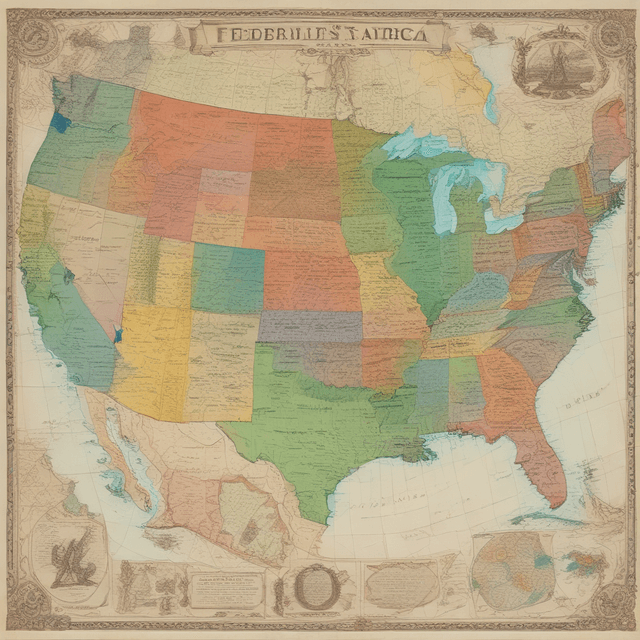
| Name | Federated States of America |
| Type | Confederation of semi-autonomous states |
| Formed | After the American Civil War of the 1860s |
| Advantages | Allows for greater experimentation and variation between the constituent states |
| Economic models | Diverse, with varying economic approaches among the states |
| Global influence | More limited role on the global stage compared to the historical United States |
| Political system | Decentralized, with a variety of political systems among the constituent states |
| Cultural identity | Shared heritage, but wide diversity of cultural identities across the states |
| Technological and economic development | Generally lagging behind the historical United States |
The Federated States of America, commonly referred to as the FSA or simply the Federated States, is a confederation of semi-autonomous states that arose from the ashes of the American Civil War in the 1860s. Rather than reuniting under a strong central government, the Union states that prevailed in the conflict fractured into a loose federation with a limited federal authority.
The American Civil War of 1861-1865 ended very differently in this timeline. While the Union forces were ultimately victorious over the Confederacy, the aftermath saw the Northern states refuse to fully reintegrate their former rivals. A series of bitter disputes over the extent of federal power, slavery, and the status of freed slaves led to the Union itself splintering into multiple independent states.
By 1868, the Federated States of America had coalesced, with most former Union states joining the new confederation. However, a handful, such as Massachusetts and New York, opted to remain independent. The Confederacy itself also fractured, with some states rejoining the Federated States while others formed separate republics.
The following decades saw the Federated States struggle to establish a functional governance model, with an ongoing tug-of-war between centralists favoring a stronger federal union and states' rights advocates seeking maximum autonomy. This political instability was exacerbated by economic and social divides between the various regions.
The Federated States of America is structured as a confederation, with a weak federal government and a high degree of sovereignty for the individual member states. Each state has its own constitution, government, and legal system, with the central FSA authority limited to a handful of shared responsibilities like national defense, foreign relations, and economic policy coordination.
The central government is led by a Presidium, a collective executive body with representatives from each state. The Presidium is responsible for FSA-wide policy decisions, but individual states maintain a high degree of independence in implementing and enforcing those policies. There is also a bicameral Federal Congress, with a Senate representing the states and a House of Representatives elected by popular vote.
However, the balance of power between the federal and state governments has fluctuated considerably over the Federated States' history. Some periods have seen states aggressively assert their sovereignty, while other eras have witnessed periodic efforts to strengthen the central authority. This has resulted in an unstable and often chaotic political environment across the FSA.
The economy of the Federated States is highly decentralized, with each state pursuing its own economic development strategies and policies. Some states maintain market-oriented, capitalist systems, while others have adopted planned socialist or mixed economies. There is also significant variation in the dominant industries, with resource extraction, manufacturing, agriculture, and finance all serving as economic engines in different regions.
This state-level economic diversity has both advantages and disadvantages. On one hand, it has allowed for experimentation and tailored approaches to regional needs. But the lack of coordination has also hindered large-scale infrastructure projects, technological advancement, and the emergence of nationwide corporations and industries. The FSA has generally lagged behind other major powers in economic growth and quality of life metrics as a result.
The Federated States exhibit a wide range of cultural identities and demographic profiles across its constituent states. While sharing a common American heritage, the states display vastly different predominant languages, religions, ethnic compositions, and social values. Some are ethnically homogeneous, while others are highly diverse.
This cultural patchwork has bred both cooperation and conflict between the states. Inter-state migration, trade, and cultural exchange has fostered a degree of national unity. But it has also sparked periodic tensions, prejudices, and even armed conflicts as states assert their distinct cultural identities and resist federal interference.
Due to its decentralized structure, the Federated States has historically played a more limited role on the global stage compared to the historical United States. While individual states maintain their own foreign relations and trade agreements, the FSA central government has struggled to project consistent power and influence internationally.
The Federated States has generally pursued a non-interventionist foreign policy, though there have been periodic exceptions. It maintains mostly cordial but distant relationships with other major powers like the British Empire, Imperial China, and the German Confederation. Economic and technological cooperation has been constrained by the FSA's internal divisions and relative weakness.
Technological development and innovation in the Federated States has tended to lag behind other advanced nations, a consequence of its political fragmentation and lack of centralized investment. While individual states have produced notable scientific and engineering breakthroughs, the FSA as a whole has struggled to mobilize resources for large-scale, long-term R&D projects.
However, the state-level autonomy has also allowed for more experimentation, with certain regions pioneering advances in renewable energy, biotechnology, and information technology despite the national-level challenges. The future trajectory of innovation in the Federated States remains uncertain, as the balance between decentralization and coordination continues to evolve.
